
Is Your Family Ready for Sleep Training? A Readiness Guide From an NP and Mom

If you have spent any time in the baby sleep corner of the internet, you’ve probably seen a dozen different opinions on when and how to sleep train. What you probably haven’t seen is someone asking the question that actually matters first: are you and your baby ready?
As a Nurse Practitioner, I get asked about sleep training constantly.
As a mom who has been in the trenches at 2am with a baby who did not read the parenting books, I also know that readiness is not just a checklist. It’s a feeling in your gut, backed up by a few things you can actually verify.
Let’s walk through both to determine if you are ready for sleep training.
If you already know you are ready and want to research the types of sleep training options, check out this post.
Sleep Training Is a Choice, Not an Obligation
First, the reassurance a lot of parents need. There is no clinical requirement that every baby be sleep trained by a certain age. Research on sleep training generally shows it can be effective for families who choose it, but it does not say every family has to do it. If your current setup, whatever it looks like, is working for your household, you are not behind and you do not need to change anything because someone on Instagram said your baby should be sleeping through the night by now.
I remember feeling this pressure myself. Everyone had an opinion about what my baby’s sleep should look like, and it took me longer than I would like to admit to realize that our arrangement was fine because it was working for us, not because it matched someone else’s timeline.
Why Timing Matters More Than Method
Here’s something that gets left out of a lot of sleep training content. The method matters less than the timing. A great method attempted at the wrong time, whether developmentally, physically, or emotionally, tends to fail. Not because the method is flawed, but because the conditions weren’t there yet.
This is usually why parents try sleep training, feel like it didn’t work, and give up feeling defeated. In many cases the issue wasn’t the approach. It was starting before the family was actually ready.
Readiness Questions for Your Baby
Before committing to a plan, walk through these honestly.
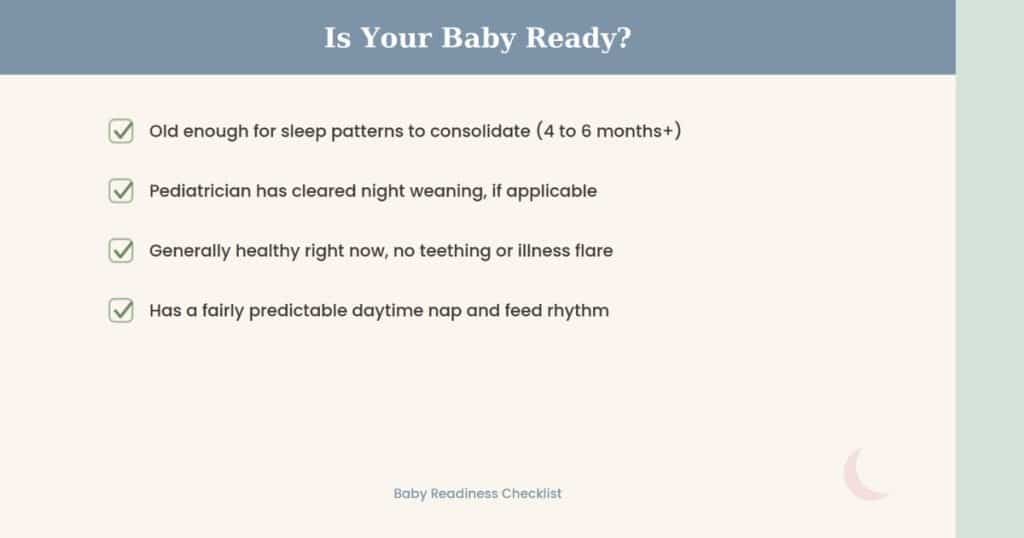
Is your baby old enough? Most infant sleep specialists point to somewhere around four to six months as the earliest window where circadian rhythm and melatonin production mature enough for longer stretches to be biologically realistic.
Has your pediatrician cleared night weaning? If you are reducing night feeds, this should be a conversation with your baby’s provider first, especially with any weight or feeding concerns.
Is your baby generally healthy right now? Teething, illness, a recent vaccine, or a developmental leap are all reasons to pause. Sleep training during a rough patch usually means more crying and less progress.
Does your baby already have a fairly predictable daytime rhythm? A baby whose naps and feeds are scattered usually needs a more stable daytime foundation before nighttime changes will stick.
Readiness Questions for You
Baby readiness is only half the picture. Your own readiness matters just as much.
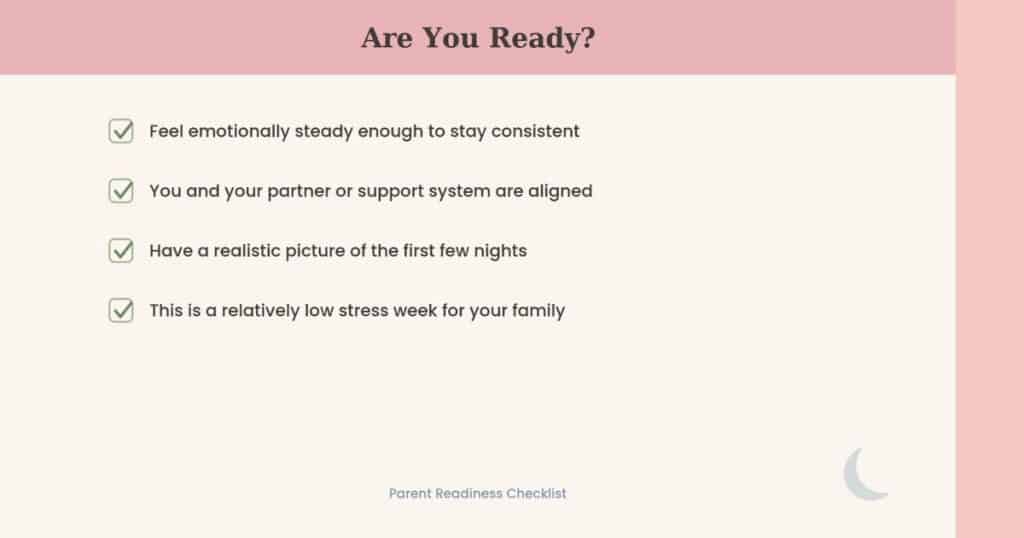
Do you feel emotionally steady enough to stay consistent? Sleep training methods work through consistency. If you cannot realistically follow through for several nights in a row right now, it’s worth waiting until you can.
Are you and your partner or support system aligned? Mixed responses at night confuse the process and slow things down. Get on the same page before you start.
Do you have a realistic picture of what the first few nights might look like? Most methods involve some protest crying before things improve. Knowing this ahead of time makes a real difference in whether parents stick with a plan.
Is this a relatively low stress week? Starting during a move, a return to work, travel, or a family crisis stacks stress on stress. A calmer stretch sets everyone up for a better outcome.
A Few Mom Tips, Not Just the Clinical Ones
Beyond the checklist, here is what I wish someone had told me.
Give yourself a trial run before the real thing. A night or two of paying close attention to your baby’s cues, without any pressure to change anything, can tell you a lot about whether you are truly ready to hold a boundary at 3am.
Line up support before you start, not after night one goes badly. Whether that’s your partner taking a shift, a family member on call, or just texting a friend who has been through it, know who you can lean on before you are in the thick of it.
Do not compare your night three to someone else’s highlight reel. What you see online is rarely the full picture, and every baby responds differently.
How to Prepare for the Next Step
If you have gone through the questions above and feel ready, here is how to set yourself up well.
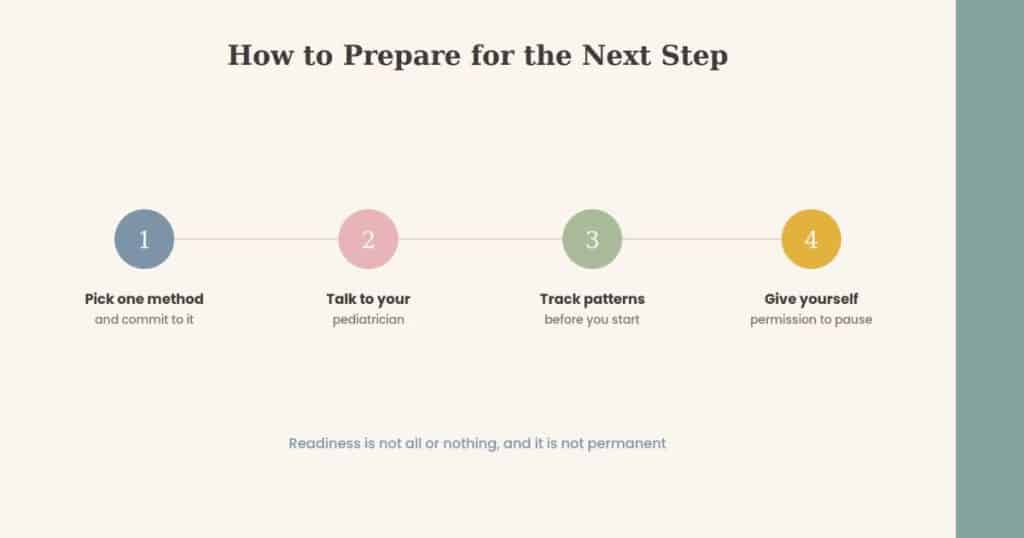
Pick one method and commit to it. Research your options, choose the one that fits your family’s values and temperament, and give it a real chance before switching to something else.
Talk to your pediatrician if anything feels uncertain, especially around night weaning, reflux, or existing health concerns.
Track your baby’s patterns before you start. Knowing current nap times, wake windows, and typical night wakings gives you a baseline, so you can actually tell if something is improving instead of guessing. This is one of the reasons I built the Latchd app. It lets you log feeds, naps, and wake ups in seconds and shows you the pattern behind the chaos, with a decision guide built by an NP and IBCLC walking through this exact readiness process.
Give yourself permission to pause. If something feels wrong for your gut or your baby’s health, it is okay to stop and revisit later. Readiness is not all or nothing, and it is not permanent.
A Few Things That Made This Season Easier
A handful of items that tend to help families through the sleep training window, whether they are just getting more consistent with a routine or in the thick of a method.


A reliable white noise machine. Consistent sound helps mask household noise and supports the sleep environment during a stretch where consistency matters most. [Insert Amazon link]
A sleep sack sized for your baby’s age and season. A safe, consistent sleep setup removes one more variable while you are working on everything else. [Insert Amazon link]
A video monitor with night vision. Being able to check on your baby without a hallway light or an opened door matters more during a check in method, when you want to observe without fully engaging. [Insert Amazon link]
A dim, low stimulation night light for feeds or check ins, so you are not fully waking your baby, or yourself, more than necessary. [Insert Amazon link]
As always, these are optional supports, not requirements. The goal is a setup that works for your family, not a shopping list you have to check off.
The Bottom Line
There is no universal deadline for sleep training, and there is no version of parenting where every family has to approach it the same way. If your current setup is working, you are not behind. And if you are ready to make a change, doing it with a clear picture of your baby’s readiness and your own will get you a lot further than jumping in because of pressure or a deadline that was never really real.
Jennifer is a Nurse Practitioner and International Board Certified Lactation Consultant. This post is for informational purposes and is not a substitute for individualized medical advice. Always check with your baby’s pediatrician for guidance specific to your child.
