
The Complete Guide to Breastfed Baby Poop: Colors, Frequency, and What’s Normal

Worried about your breastfed baby’s bowel movements? This comprehensive guide covers everything from newborn meconium to the big changes that come with solid foods.
If you’re constantly analyzing the contents of your baby’s diaper, wondering if that shade of yellow is normal, or panicking because your little one hasn’t pooped in three days – you’re not alone. I see so many patients in my office with worried parents when stool patterns change- usually around 4 weeks. Let’s get into the details of your breastfed baby poop concerns.
As a nurse practitioner I want you to understand what’s normal when it comes to breastfed baby poop so I can save you from sleepless nights and unnecessary worry.
As parents, we scrutinize every aspect of our baby’s health, and bowel movements are often our biggest source of anxiety. The good news? Breastfed baby poop has a much wider range of “normal” than you might expect.
What to Expect in the First Few Days: Meconium and Transitional Stools
The Meconium Phase (Days 1-3)
Your baby’s first bowel movements will look nothing like what you’ll see later. Meconium is a thick, sticky, tar-like substance that ranges from dark green to black. This is completely normal and consists of everything your baby ingested while in the womb – amniotic fluid, skin cells, and digestive secretions.
Key Timeline:
- First meconium should pass within 24-48 hours
- May continue for 2-3 days
- Gradually transitions to lighter colors
When to Call Your Pediatrician: If your baby hasn’t passed meconium within 48 hours of birth, contact your healthcare provider immediately.
Transitional Stools (Days 3-5)
As your milk supply establishes and baby gets more colostrum, you’ll notice transitional stools – typically greenish-brown and less sticky than meconium. This phase usually lasts 2-3 days as your baby’s digestive system adapts to breast milk.
The “Gold Standard”: What Normal Breastfed Baby Poop Looks Like
Once breastfeeding is well-established (usually by day 5), here’s what you can expect:
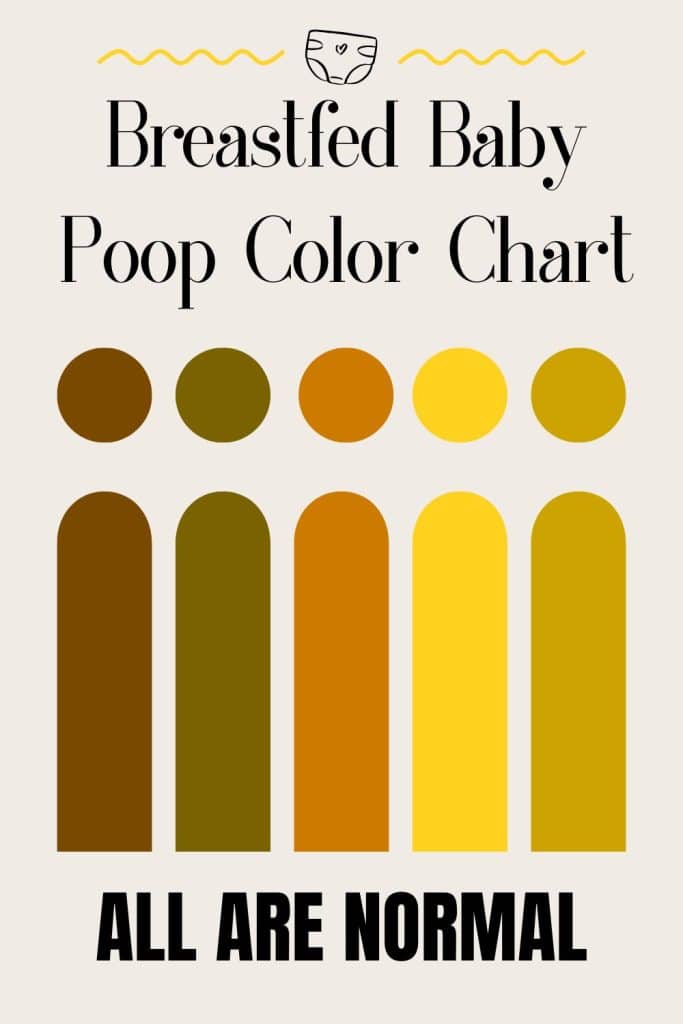
Color Variations (All Normal!)
- Mustard yellow: The classic “gold standard”
- Bright yellow to orange: Common variations
- Slightly green: Often related to your diet or foremilk/hindmilk balance
- Tan or brown: Less common but still normal
Texture and Consistency
Normal breastfed baby poop should be:
- Soft and loose: Almost liquid consistency
- Seedy: Those white or yellow specks are normal milk curds
- Smooth: No hard pieces or pellets
Smell
Unlike formula-fed babies, breastfed baby poop typically has:
- Mild, sweet smell
- Sometimes tangy or slightly sour
- Generally not offensive or strong
Why the difference? Breast milk is incredibly digestible, leaving very little waste product and fewer odor-causing bacteria.
For more graphic photos, check out this link https://www.babycenter.com/baby-poop-photos
Frequency Expectations: How Often Should Your Breastfed Baby Poop?
This is where many parents get confused, because the range of normal is surprisingly wide.
Newborns (0-4 weeks)
- Frequency: 3-8 times per day
- Pattern: Often after every feeding
- Why so often: High milk intake, efficient digestion, immature digestive system
Older Babies (4 weeks – 6 months)
Here’s where it gets interesting – and where many parents unnecessarily worry.
Some babies continue frequent bowel movements (multiple times daily), while others may go days without pooping. Both patterns can be completely normal!
The 7-10 Day Rule: A breastfed baby can go up to 7-10 days without a bowel movement and be perfectly fine. This happens because:
- Breast milk is so perfectly formulated there’s minimal waste
- Baby’s digestive system becomes more efficient
- Individual variations are normal
My own first baby went 11 days between pooping! We did use a glycerin suppository just to help our own conscience. Which is an easy fix if it seems like your little one is getting uncomfortable.
What Matters More Than Frequency
Focus on these indicators instead:
- Baby’s overall comfort and happiness
- Normal eating patterns
- Adequate wet diapers (6-8 per day after day 5)
- Steady weight gain
Bottom line, if they are still eating well, their belly is soft, they are passing gas, no worries!
Red Flags: When to Contact Your Pediatrician
While breastfed baby poop has a wide range of normal, certain signs warrant medical attention:
Immediate Concerns
- Hard, pellet-like stools: Suggests constipation (rare in breastfed babies)
- Bright red blood: Small streaks can be normal, but significant amounts need evaluation
- Black stools: After the meconium phase, this could indicate bleeding
- White or clay-colored stools: May indicate liver problems
- Explosive, watery diarrhea with fever: Signs of infection
Changes in Pattern
- Sudden changes from baby’s normal routine
- Signs of discomfort during bowel movements
- Decreased appetite or lethargy
- Fever accompanying changes in stool

The Solid Food Game-Changer: What Happens at 6 Months
Introducing solid foods around 6 months brings dramatic changes to your baby’s bowel movements. Prepare yourself!
The Big Changes
Smell: Those sweet-smelling breastfed poops become a thing of the past. Solid food waste has a much stronger, more adult-like odor.
Color: Get ready for rainbow variety! Your baby’s poop will now reflect their diet:
- Red from beets or tomatoes
- Orange from carrots or sweet potatoes
- Green from leafy vegetables
- Dark from blueberries or iron-fortified foods
Texture: Much more formed and solid, transitioning from liquid to paste-like consistency.
Frequency: Usually becomes more predictable, often once daily.

What’s Normal with Solids
- Undigested food pieces: Corn kernels, tomato skins, and other fibrous foods are common
- Varied colors: Directly related to foods consumed 1-3 days prior
- Firmer consistency: No longer the liquid consistency of exclusive breastfeeding
- Stronger smell: More similar to adult bowel movements
Constipation Signs
With solid foods, true constipation becomes more possible:
- Hard, dry, pellet-like stools
- Extreme difficulty or pain during bowel movements
- Less frequent than baby’s established pattern
- Blood from straining
Solutions: Increase water intake, offer high-fiber foods like prunes or pears, and ensure adequate breast milk continues.
I encourage my moms in my office to offer some “p” fruits in the beginning of their solid food experience- think “P for Poop”. Peaches, pears, prunes, papaya. Also, carrots are great. These are great natural ways to avoid the constipation issues that can come with changes to their diet. The iron in the infant cereals will be better absorbed with Vit C as well, so that’s an added bonus!
For a full Infant Feeding Survival Guide to walk you through the first year, check out this post.
Practical Tips for Parents
Keep a Simple Log
Especially in the early weeks, noting frequency and any significant changes helps you:
- Establish your baby’s normal pattern
- Provide useful information to healthcare providers
- Track correlations with feeding or your diet
Trust Your Parental Instincts
You know your baby better than anyone. If something feels “off,” even if it falls within the range of normal, don’t hesitate to consult your pediatrician.
Diet Connections
Your diet can affect your baby’s stool:
- Green vegetables may cause green-tinted stools
- Dairy sensitivity might cause mucousy or blood-streaked stools
- High-fiber foods can affect consistency
Stain Management
Yellow breastfed baby poop stains are notoriously difficult to remove:
- Rinse immediately with cold water
- Sun-dry when possible (natural bleaching)
- Use enzyme-based stain removers
- Consider dedicated “blowout” outfits

Every Baby is Different
Remember that even within the same family, babies can have completely different bowel movement patterns. Your first child might have pooped after every feeding, while your second might go days between movements – both completely normal!
The Bottom Line
Breastfed baby poop varies much more than formula-fed baby poop, which can be both reassuring and anxiety-provoking. The key is understanding that this wide variation is actually a sign of how perfectly breast milk is designed for your baby.
When in doubt:
- Focus on your baby’s overall well-being rather than just poop frequency
- Look for patterns and changes rather than isolated incidents
- Trust your instincts while understanding the wide range of normal
- Don’t hesitate to contact your healthcare provider with concerns
Understanding what’s normal can transform those diaper changes from moments of anxiety into routine care. Your baby’s digestive health is just one piece of their overall well-being, and breastfed babies have the advantage of receiving the most digestible, perfectly-formulated nutrition available.
Want More Breastfeeding Support?
Navigating breastfeeding challenges doesn’t have to feel overwhelming. My comprehensive breastfeeding ebooks provide evidence-based guidance on everything from establishing supply to troubleshooting common concerns. Get the support you need to feel confident in your feeding journey.
https://justaskjennp.com/shop/
Remember: This information is educational and not a substitute for professional medical advice. Always consult your pediatrician with specific concerns about your baby’s health.
Frequently Asked Questions
Q: Is it normal for my breastfed baby to go a week without pooping? A: Yes! Breastfed babies can safely go 7-10 days without a bowel movement, as long as they’re comfortable, eating well, and having wet diapers.
Q: Why is my baby’s poop green? A: Green poop in breastfed babies is usually normal and can be caused by your diet, foremilk/hindmilk imbalance, or natural variation.
Q: When should I worry about blood in my baby’s stool? A: Small streaks of blood can be normal from minor tears, but significant amounts or blood mixed throughout the stool should be evaluated by your pediatrician.
Q: How will I know if my breastfed baby is constipated? A: True constipation in breastfed babies is rare. Look for hard, pellet-like stools and signs of discomfort, rather than just infrequent bowel movements.
